
 en
en


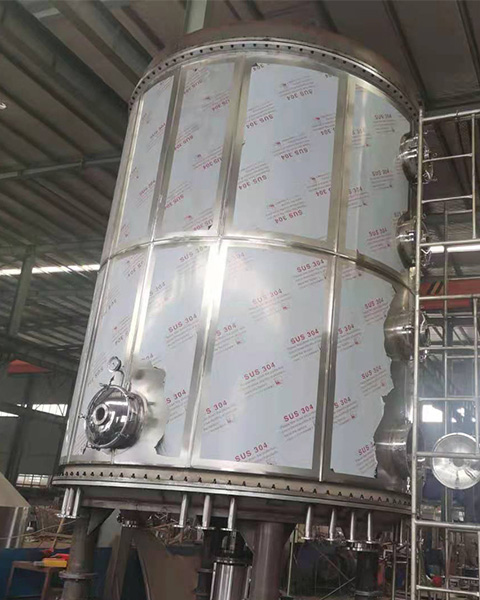
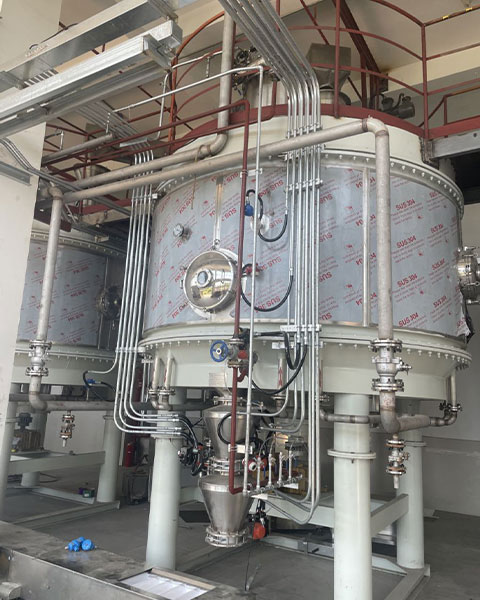
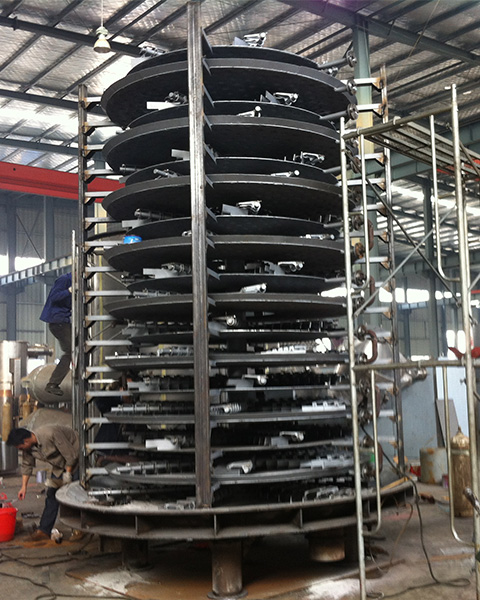
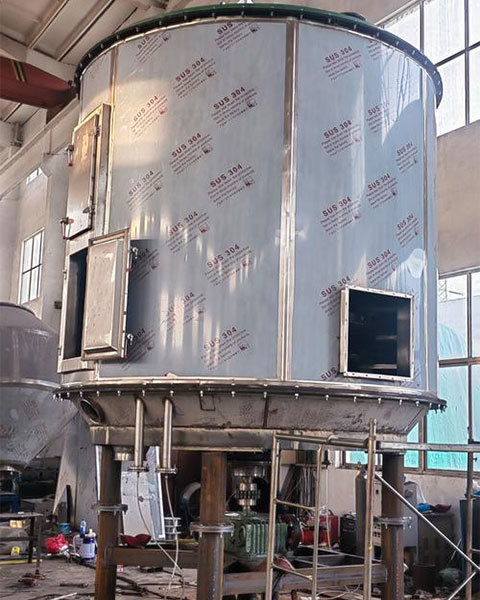
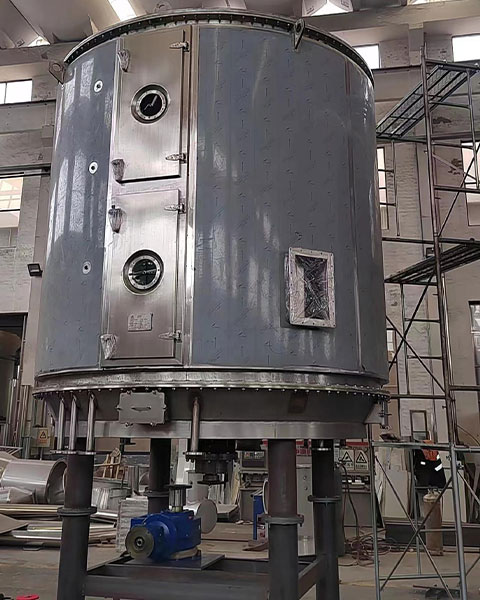
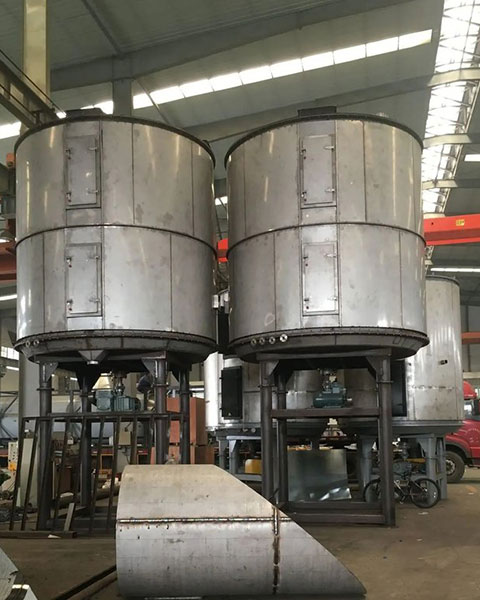
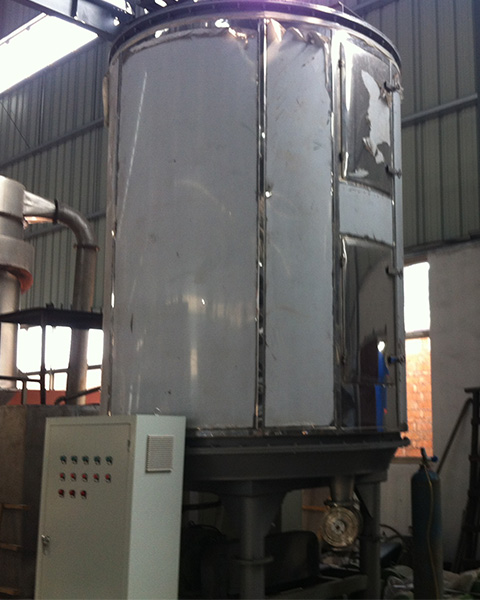
PLG-Disc Continuous Dryer
product introduction
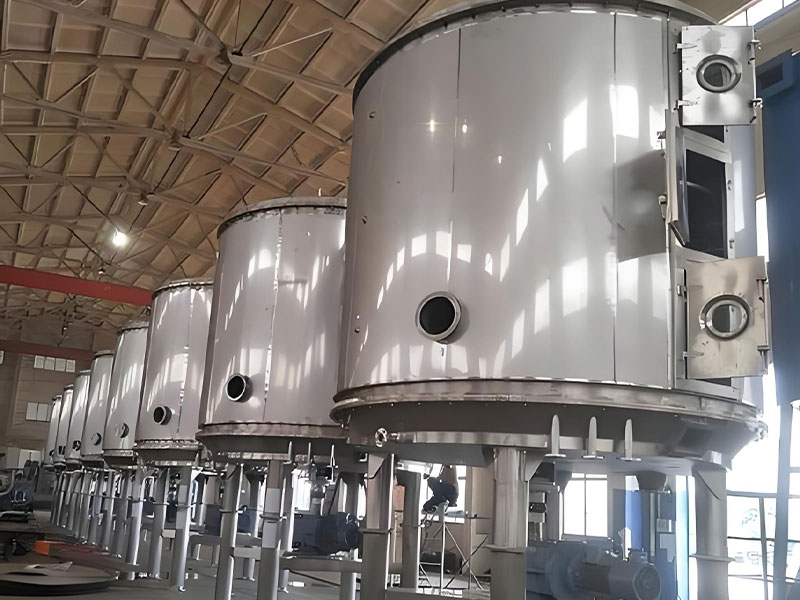
Disc continuous dryer is an efficient conductive continuous drying equipment. Its unique structure and working principle determine that it has the characteristics of high thermal efficiency, low energy consumption, small floor area, simple configuration, convenient operation and control, and good operating environment. It is widely used in chemical, medicine, pesticides, food, feed, agricultural and sideline product processing and other industries. Drying operations. It has been well received in practice in various industries. It now produces and manufactures three major types: atmospheric pressure, airtight and vacuum, four types: 1200, 1500, 2200 and 3000. A(carbon steel), B(stainless steel is evenly distributed in the parts contacting the material), and C (on the basis of B, add the steam pipes, main shafts and brackets to stainless steel, and the cylinder body and cover top are lined with stainless steel). Three materials, drying area 4 - 180 m2, a total of hundreds of models of series products, and can provide matching auxiliary equipment to meet the needs of users for drying various materials.
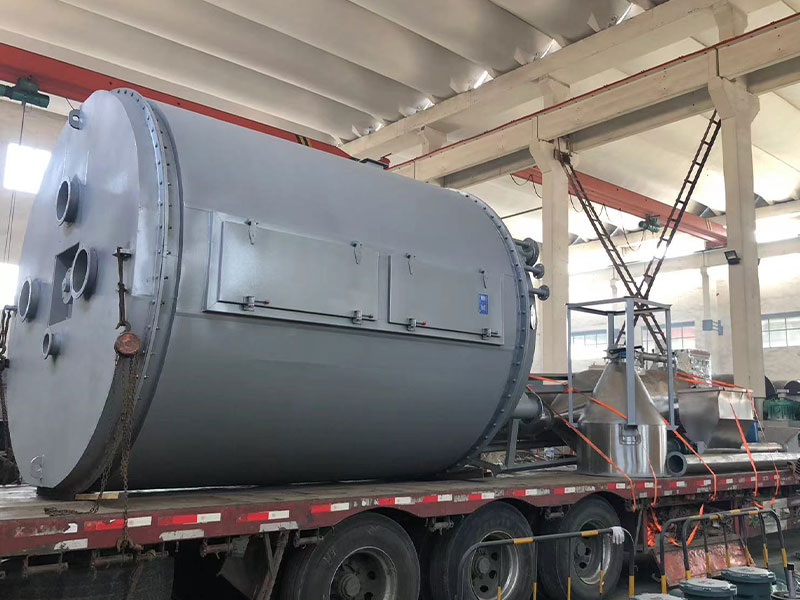
working principle
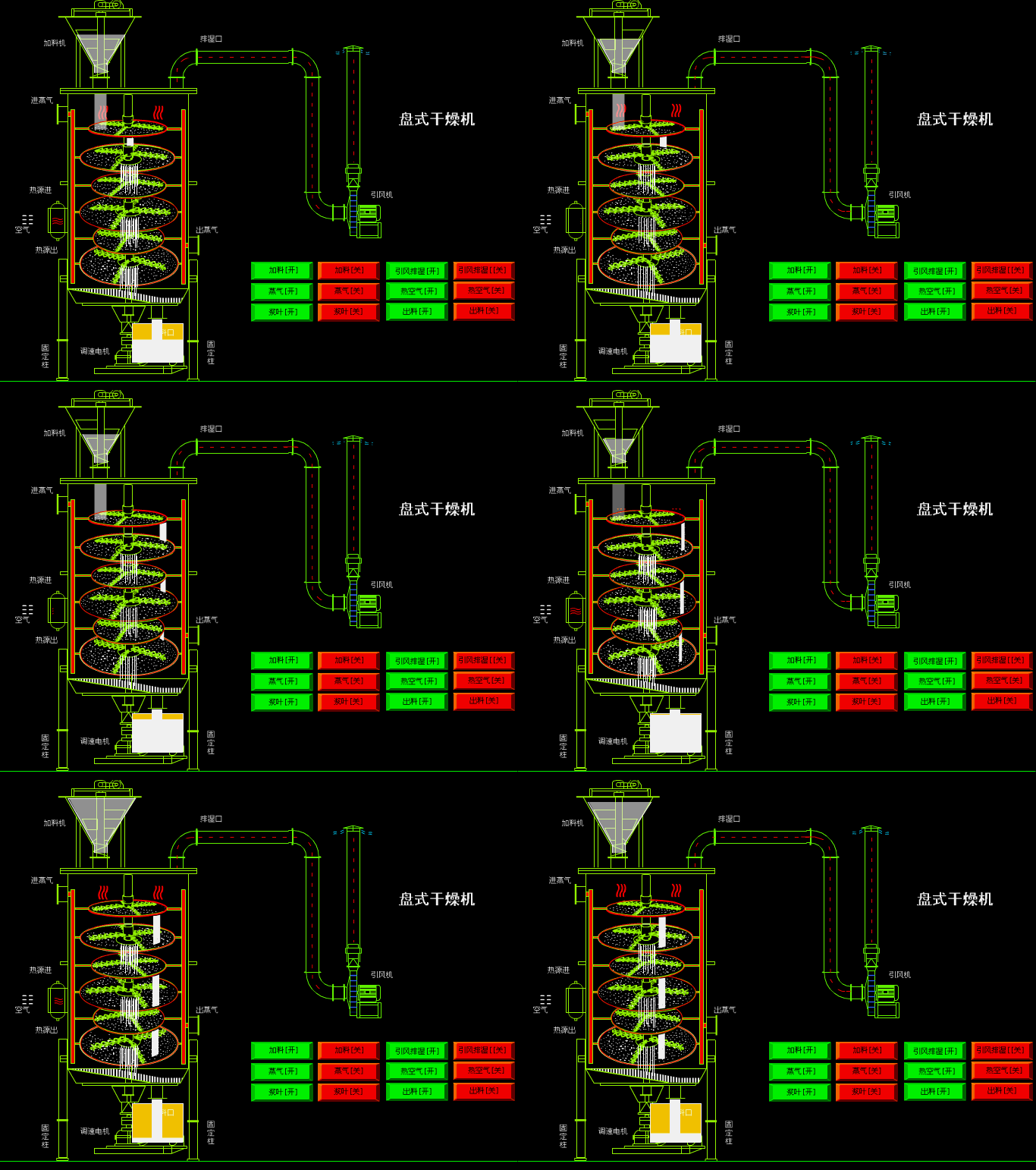
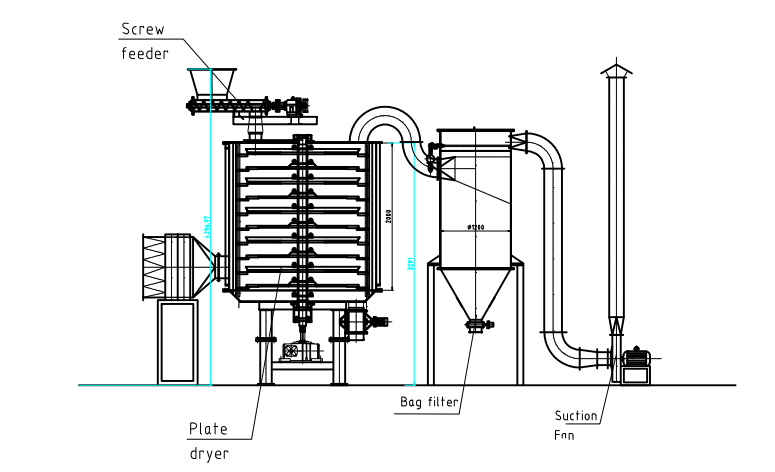
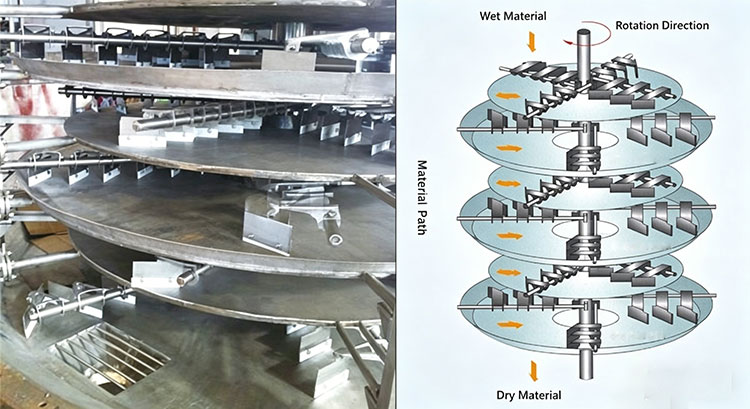
Wet material is continuously added from the feeder to the first layer of drying pan in the upper part of the dryer. The harrow arm with harrow blades makes a rotary motion to make the harrow arm make a rotary motion to make the harrow blades continuously turn over the material. The material flows along the surface of the drying pan along an exponential spiral. The material on the small drying pan is transferred to the outer edge and falls to the outer edge of the large drying pan below. On the large drying pan, the material moves inward and falls from the middle drop. Drop into the next layer of small drying pan. Large and small drying trays are arranged alternately up and down so that the material can flow continuously through the entire dryer. Heating medium is introduced into the hollow drying plate. The heating medium takes the form of saturated steam, hot water and heat transfer oil. The heating medium enters from one end of the drying plate and is led out from the other end. The dried material falls from the next drying tray to the bottom layer of the shell, and is then transferred to the discharge port by the rake blades for discharge. Moisture escapes from the material and is discharged through the moisture outlet arranged on the top cover. Moisture from the vacuum type tray dryer is discharged through the vacuum pump outlet arranged on the top cover. Dry material discharged from the bottom layer can be packaged directly. By adding auxiliary machines such as finned heaters, solvent recovery condensers, bag filters, dry material back-mixing mechanisms, and induced draft fans, its drying production capacity can be improved. Paste paste and heat-sensitive materials can be dried, and solvents can be easily recovered., and pyrolysis and reaction operations can be carried out.
performance characteristics
(1) Easy regulation and strong applicability
◎ The drying process is optimized by adjusting the thickness of the material layer, the speed of the spindle, the number of harrow arms, and the type and size of the harrow blades.
◎ Each layer of drying pan can be heated or cooled separately by introducing hot medium or cold medium. The material temperature control is accurate and easy.
◎ The retention time of the material can be adjusted ^.
◎ The flow direction of the material is single, there is no back-mixing phenomenon, the drying is uniform, the quality is stable, and there is no need to mix again.
(2) Simple and easy operation
◎ Driving and parking the dryer is very simple.
◎ After stopping feeding, the conveying material dirt rake blades can quickly empty the material in the dryer.
◎ Through the special large inspection door mirror, you can carefully clean and observe the inside of the equipment.
(3) Low energy consumption
◎ The material layer is very thin, the spindle speed is low, the material conveying system requires less power and less power consumption.
◎ Drying is carried out with conductive heat, with high thermal efficiency and low energy consumption.
(4) Good operating environment, recyclable solvents, and dust emissions meet requirements
◎ Atmospheric pressure type: Due to the low air flow speed in the equipment and the low humidity distribution in the equipment, it is difficult for dust to float to the top of the equipment, so the exhaust gas discharged from the top moisture outlet contains almost no dust.
◎ Closed type: Equipped with a solvent recovery device, it can easily recover organic solvents in hygroscopic gas. The solvent recovery device is simple and has a high recovery rate. For flammable, explosive, toxic and easily oxidizable materials, nitrogen can be used as a moisture-carrying gas for closed-loop circulation to make it safe to operate. Especially suitable for drying flammable, explosive and toxic materials.
◎ Vacuum type: A tray dryer operated under vacuum, especially suitable for drying heat-sensitive materials.
(5) Easy installation and small floor area
◎ Dryer whole factory, overall transportation, just lifting in place, installation positioning is very easy.
◎ Due to the drying tray layout and vertical installation, even if the drying area is large, the floor area is also small.
technical characteristics
(1) Drying pan
◎ Design pressure: Generally 0.4MPa,^Up to 1.6MPa.
◎^High operating pressure: generally ≤0.4MPa,^Up to 1.6MPa.
◎ Heating medium: Steam, hot water, heat transfer oil, dry plate temperature is 100℃, hot water is used to heat, saturated water vapor or superheated steam is used to heat at 100℃ to 150℃, heat is used to heat at ≤0.4MPa, heat is used to heat at 150℃ to 320℃, heat is used to heat, heat transfer oil, molten salt, etc. when>320℃.
(2) Material conveying system
◎ Spindle speed: 1~10 rpm, electromagnetic or frequency conversion stepless speed regulation.
◎ Harrow arms: There are 2 to 8 harrow arms fixed on the main shaft on each layer of drying plate.
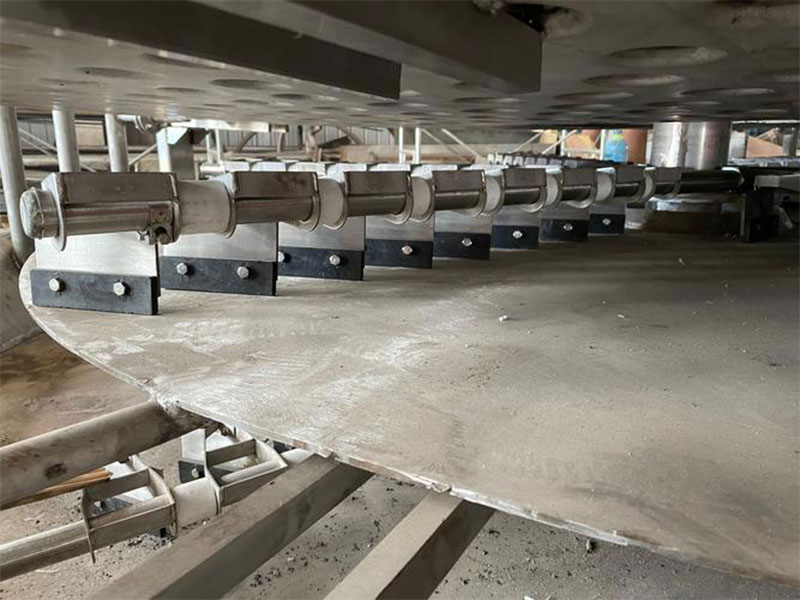
◎ Harrow blades: They are hinged on the harrow arm and can float up and down with the disk surface to maintain contact. There are many forms.
◎ Rolling: For materials that are easy to agglomerate and need to be crushed, adding rolling in appropriate locations can enhance the heat transfer and drying process.
(3) The shell is available in three types: atmospheric pressure, airtight and vacuum
◎ Normal pressure type: cylinder or octagonal prism type, with two structures: whole and half. The main pipe for inlet and outlet of the heating medium can be inside or outside the shell.
◎ Closed type: Cylindrical shell can withstand the internal pressure of 5Kpa. The main pipe for inlet and outlet of heating medium can be inside or outside the shell.
◎ Vacuum type: cylindrical shell, design pressure is 0.1Mpa, and main pipes for inlet and outlet of heating medium are inside the shell.
(4) Air heater
It is generally used when the evaporation amount is large to enhance drying efficiency.
Adapt materials
Drying pyrolysis combustion cooling reaction sublimation
Organic chemical products, inorganic chemical products, medicine, food, feed, fertilizer.
technical parameters
| specifications | Outer diameter mm | height mm | Drying area m2 | power Kw |
| 1200/4 | Φ1850 | 2718 | 3.3 | 1 |
| 1200/6 | 3138 | 4.9 | ||
| 1200/8 | 3558 | 6.6 | 1.5 | |
| 1200/10 | 3978 | 8.2 | ||
| 1200/12 | 4398 | 9.9 | 2.2 | |
| 1500/6 | Φ2100 | 3022 | 8.0 | |
| 1500/8 | 3442 | 10.7 | ||
| 1500/10 | 3862 | 13.4 | ||
| 1500/12 | 4282 | 16.1 | 3.0 | |
| 1500/14 | 4702 | 18.8 | ||
| 1500/16 | 5122 | 21.5 | ||
| 2200/6 | Φ2900 | 3319 | 18.5 | |
| 2200/8 | 3739 | 24.6 | ||
| 2200/10 | 4159 | 30.8 | 4.0 | |
| 2200/12 | 4579 | 36.9 | ||
| 2200/14 | 4999 | 43.1 | 5.5 | |
| 2200/16 | 5419 | 19.3 | ||
| 2200/18 | 5839 | 55.4 | 7.5 | |
| 2200/20 | 6259 | 61.6 | ||
| 2200/22 | 6679 | 67.7 | 11 | |
| 2200/24 | 7099 | 73.9 | ||
| 2200/26 | 7519 | 80.0 |
| specifications | Outer diameter mm | height mm | Drying area m2 | power Kw |
| 2500/6 | Φ3150 | 3319 | 26.3 | 4 |
| 2500/8 | 3739 | 35 | ||
| 2500/10 | 4159 | 43.8 | 5.5 | |
| 2500/12 | 4579 | 52.5 | ||
| 2500/14 | 4999 | 61.3 | 7.5 | |
| 2500/16 | 5419 | 70 | ||
| 2500/18 | 5839 | 78.8 | 11 | |
| 2500/20 | 6259 | 87.5 | ||
| 2500/22 | 6679 | 96.3 | ||
| 2500/24 | 7099 | 105 | 13 | |
| 2500/26 | 7519 | 113.8 | ||
| 3000/8 | Φ3800 | 4050 | 48 | 11 |
| 3000/10 | 4650 | 60 | ||
| 3000/12 | 5250 | 72 | ||
| 3000/14 | 5850 | 84 | ||
| 3000/16 | 6450 | 96 | ||
| 3000/18 | 7050 | 108 | 13 | |
| 3000/20 | 7650 | 120 | ||
| 3000/22 | 8250 | 132 | ||
| 3000/24 | 8850 | 144 | ||
| 3000/26 | 9450 | 156 | 15 | |
| 3000/28 | 10050 | 168 |
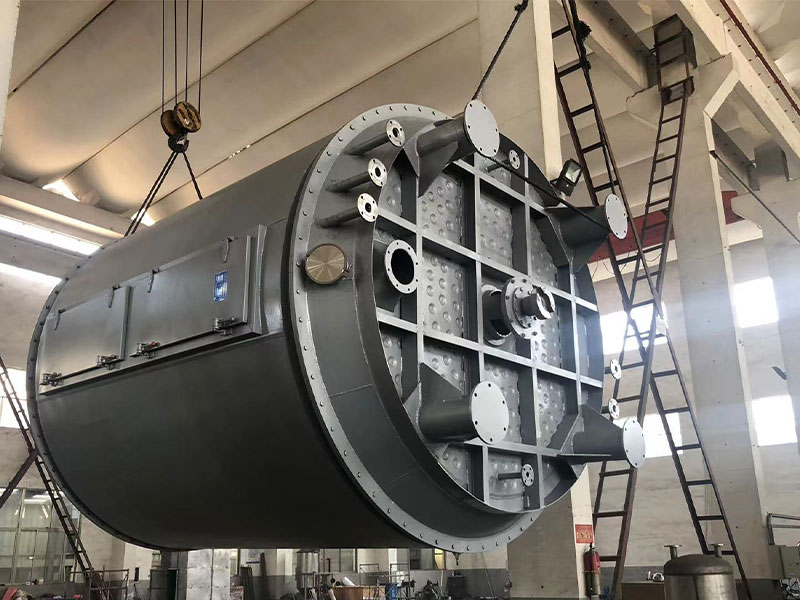
PLG304 stainless steel continuous disc plate dryer